



Introduction: When DIY Fishing Gear Gets Next-Level
Let’s be real-we’ve all seen anglers get crafty. Homemade floats? Sure, that’s weekend project stuff. Custom rods? Impressive, but there’s a community for that. But a homemade fishing keepnet? Weaving it from scratch with Dyneema line? That’s the kind of next-level dedication that makes you go, “Wait, people actually do that?” Spoiler: They do. And I recently stumbled on a pro angler’s journey that blew my mind. Today, we’re diving into how this die-hard fisherman spent 17 days crafting a Japanese-style keepnet with 1500 meters of 8lb colored Dyneema PE line. Trust me, this isn’t your average trip to the tackle shop.
Why Dyneema Line for a Fishing Keepnet?
First, let’s talk about the star of the show: Dyneema PE line. If you’re a fishing nerd, you know Dyneema is the superhero of fishing lines-stronger than steel pound-for-pound, zero stretch, and basically indestructible against abrasion. But using it for a keepnet? That’s genius. Most store-bought keepnets are made from cheap nylon that tears if you look at it wrong, or mesh that’s too big (hello, escaped minnows). Dyneema fixes all that. It’s tough enough to handle 100+ pounds of fish, won’t rot in water, and the angler could pick a small mesh size to keep even tiny catches secure. Plus, the colored line adds a cool, custom vibe-no more boring black or green nets.
Why 8lb test? It’s the sweet spot. Too light, and the mesh might stretch under heavy loads. Too heavy, and the line would be too thick to weave tight, small holes. 8lb Dyneema hits that balance: strong enough to hold big hauls, thin enough for precise weaving. And 1500 meters? Yeah, that’s a lot-but when you’re weaving a 230cm long net with tiny mesh, every centimeter counts. This angler didn’t cut corners.
The 17-Day Weaving Marathon: Slow and Steady Wins the Race
Let’s get into the grind. Weaving a keepnet with tiny mesh isn’t like knitting a scarf while watching TV. This is painstaking, eye-straining work. The angler started by setting up a frame to hold the line taut-critical for keeping the mesh uniform. Then, they began the repetitive (but weirdly satisfying) process of looping and knotting the Dyneema line to create the netting. Each tiny hole took minutes to weave, and with a net this size? You do the math. 17 days of this? That’s dedication. I’d probably quit after day 3 and order a net on Amazon. But not this pro.
Here’s a peek at the progress (shoutout to the photos they shared-they tell the story way better than words):

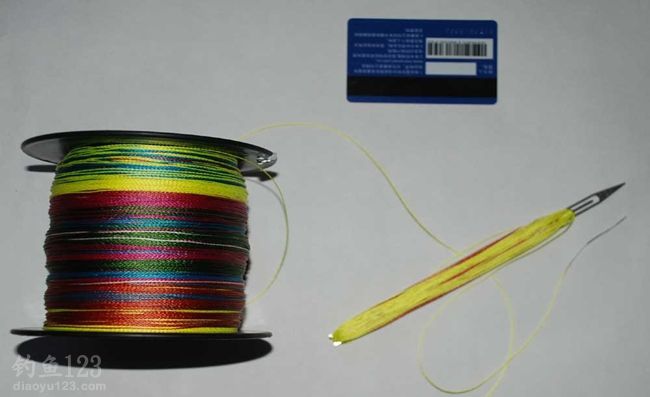
The first photo shows the initial frame setup: spools of colored Dyneema line stretched tight, ready to be transformed. You can see the angler’s tools-simple, but effective. No fancy machines here; just hands, patience, and a lot of coffee, I’m sure.

By day 5, the net started taking shape. The tiny mesh holes are already visible, and you can tell the angler was meticulous about keeping each one the same size. This isn’t just a net-it’s a work of art.

Day 10: The net was half done. At 230cm long, that’s 115cm of woven Dyneema-impressive, but still a long way to go. The colored line started to pop, giving the net that Japanese-style aesthetic the angler was going for.

A close-up shot shows the tightness of the mesh. You could fit a finger through it, but that’s it-perfect for keeping small fish in and predators out. The Dyneema line looks smooth but tough, like it could withstand anything.
The Final Product: A Keepnet Built to Last
After 17 long days, the net was done. Let’s talk specs-because this thing is a beast:
- Length: 230cm (that’s over 7 feet long-plenty of room for a big day’s catch)
- Bottom diameter: 48cm (wide enough to spread out fish so they don’t suffocate)
- Top diameter: 35cm (narrow enough to fit most boat or shoreline keepnet holders)
- Extras: Steel ring at the top for durability, a sturdy handle for easy carrying, and reinforced stitching at stress points (like the bottom, where most nets fail)
And the best part? The angler tested it with a 100+ pound haul of fish, and it didn’t even stretch. That’s the power of Dyneema. Store-bought nets would have torn or sagged under that weight, but this custom job held strong.

The final photo shows the keepnet fully assembled, hanging from a tree. The colored Dyneema line looks vibrant in the sunlight, and the steel ring and handle add a professional touch. This isn’t just a tool-it’s a statement. It says, “I take fishing seriously, and I build gear that matches that passion.”

Another shot lays the net flat, showing its full length and uniform mesh. You can tell every hole is identical-proof of the angler’s patience. This isn’t a rushed project; it’s a labor of love.
Why This Matters for Anglers Everywhere
You might be thinking, “Why go through all this trouble when I can buy a keepnet for $50?” Fair question. But here’s the thing: DIY gear isn’t just about saving money (though this net probably cost less than a high-end store-bought one). It’s about customization. This angler got exactly what they wanted: small mesh, maximum strength, and a unique design. They didn’t have to settle for a net that was “good enough”-they built one that was perfect for their fishing style.
Plus, there’s a sense of pride that comes with using gear you made yourself. Imagine pulling up to the lake, taking out your custom Dyneema keepnet, and watching other anglers stare. It’s a conversation starter, a way to connect with other fishing enthusiasts, and a reminder of the time and effort you put into your hobby.

One of the photos shows the angler testing the net with a big catch. The fish are packed in tight, but the net isn’t stretching or tearing. That’s the payoff. All those days of weaving? Worth it.

A close-up of the fish inside the net proves the mesh works-no escapes, no tangles. Just happy, safe fish (until they’re caught, of course).
Final Thoughts: Would You Try Weaving Your Own Dyneema Keepnet?
After seeing this journey, I’m tempted to try it-though I’d probably set aside a month (and a lot of ibuprofen for my hands). But even if you don’t want to weave your own net, this story is a reminder of how far passion can take you. Fishing isn’t just about catching fish; it’s about the community, the creativity, and the little things that make the hobby special.
If you’re a pro angler looking to upgrade your gear, or just someone who loves DIY projects, this Dyneema keepnet is inspiration. It shows that with the right materials, a ton of patience, and a love for fishing, you can build something amazing.

The last photo says it all: the angler holding their net, grinning from ear to ear. That’s the joy of DIY. All the hard work, all the late nights, all the sore fingers-worth it for that moment of pride.
So, what do you think? Is this something you’d tackle? Let me know in the comments. And if you do try it, tag me-I’d love to see your custom Dyneema keepnet.


