Competitive Fishing Rods: Why “Thin, Light, Stiff” Isn’t Just a Buzzword (But Also Has Its Limits)
Let’s cut to the chase: if you’ve ever watched a competitive fishing match, you’ve probably noticed the pros using rods that look like they could double as a toothpick. Thin, feather-light, and so stiff you could probably use it to stir your coffee without bending—what’s the big deal? Spoiler: it’s all about the fish, the rules, and the chaos of tournament fishing. I’ve spent way too many weekends watching (and sometimes failing miserably at) local competitions, so let’s break down why these rods exist, when they work, and when they’ll leave you crying with a broken rod and empty net.
First: The “Thin, Light, Stiff” Triad Explained (Because Fish Are Tiny in Tournaments)
Here’s the thing: competitive fishing isn’t like your weekend lake trip where you’re hoping for a 10lb bass. Most tournament events (especially for target fish) are designed with super-specific fish sizes. We’re talking 30-50g for small crucian carp, 100g for medium, and 250g+ for “big” ones. These aren’t monsters—they’re the size of your palm. So why does the rod need to be built like a race car?
Thin = Perfect for Small Fish (But Wait, No Standard?)
Thin rods (think 0.7mm tip diameter, 9.5-13mm butt diameter) are made for tiny mouths. A thick rod would feel like shoving a baseball bat into a goldfish’s mouth—you’d either miss the bite entirely or rip the hook through its jaw. But here’s the kicker: there’s no “official” thinness. A 13.5mm butt might feel perfect for a guy with giant hands, but for someone with smaller palms, it’s like holding a baseball bat. Pro tip: if it doesn’t feel like an extension of your hand, skip it. Thin = right for you, not a number on a spec sheet.
Light = Survive 400+ Casts in 70 Minutes (Yes, That’s a Thing)
Let’s do the math: 70-minute tournament, 400+ casts, 200+ fish. If your rod weighs 100g (old school), your arm will feel like it’s going to fall off by the 30-minute mark. Modern rods? 3.6m models clock in at 48g, 4.5m at 66g, 5.4m at 90g. That’s lighter than a can of soda! How do they do it? Four tricks:
- High-tensile carbon fiber (think space-age material that’s strong but feather-light)
- Thinner diameters (pairing thin with light = double the win)
- Smart carbon layout (e.g., 46T carbon for the tip, 30T for the middle—strength where you need it, lightness where you don’t)
- Thinner walls (but don’t worry, they don’t feel like tin foil… usually)
Some rods even come with two butt caps (light and heavy) to balance the weight. I once used a rod with a heavy cap and felt like I was holding a sledgehammer—swapped it for the light one, and suddenly I could cast 10 more times without wincing. Game changer.
Stiff = Fast Hooksets (But Beware the Snap)
Stiff rods (think “fast action” or “extra fast”) let you set the hook in 0.2 seconds and yank the fish out of the water before it knows what hit it. For tiny fish, you don’t need a net—just hook, lift, and plop into the basket. A full cycle (hook to basket) takes 10 seconds max. But here’s the catch: stiff = brittle. Carbon fiber without “weft” (the little threads that hold it together) relies on resin to stay strong. Push it too hard, and snap—your rod becomes a two-piece (and not the good kind). I’ve seen three pros break rods in one tournament because they tried to muscle a 2kg carp with a stiff crucian rod. Ouch.
When “Thin, Light, Stiff” Fails (Spoiler: When You’re Fishing for Big Fish)
Let’s say you’re in a mixed-species tournament—1.5m deep water, 2kg carp and grass carp. Grab your stiff 19/28-tone rod (that’s super stiff, for non-fishermen) and you’ll be fighting the fish for 5-8 minutes. Use a softer 37-tone rod? 10 minutes. But wait—stiff rods + thin line = broken line city. If you’re using 0.6/1 line (super thin), that stiff rod will yank the line right off the spool. I learned this the hard way: tried to use my crucian rod for a 1.5kg carp, and my 0.8 line snapped before I even got the fish to the surface. RIP my favorite line.
Another problem: mixed fish that aren’t “tiny” but aren’t “giant” either. Think 300-500g carp and 150-250g crucian. Most pros still grab their thin, light rods because these “half-sized” carp don’t fight as hard. But what if you hook a 2kg grass carp? At the 2024 “Guangwei Fishing King Cup,” pro Liu Lin won with a soft rod (not thin, light, stiff) because he hooked a grass carp. If he’d used a stiff rod, his 0.3/0.6 line would’ve snapped. Luck? Maybe. But smart? Definitely.
The Catch: It’s All About the Tournament Rules (And Fish Density)
You can’t talk about these rods without mentioning fish density. In high-density tournaments (think 200+ fish in 70 minutes), the water turns into a fish soup. They start off the bottom, then move up, then stack on top of each other. You go from “bottom fishing with dough bait” to “floating fishing with paste bait” in 20 minutes. Your water line gets shorter, your casts get faster, and a heavy rod will slow you down so much you’ll finish last. I once used a 120g rod in a high-density match—by the 40th minute, I was casting once every 10 seconds instead of 5. My friend used a 60g rod and cast twice as fast. He won. I bought a new rod the next day.
Low-density tournaments? Who cares if your rod is heavy. If you’re only catching 10-15 fish in 70 minutes, a 150g rod won’t kill you. In fact, pros slow down—they wait for the “right” bite, not every tiny twitch. Stiff rods don’t help here; soft rods let you feel the bite better and avoid ripping hooks out.
Rod Types 101: Don’t Confuse Your Tournament Rod with a Stream Rod
Not all rods are created equal. Let’s sort them out:
Hand Rods (For Tournaments)
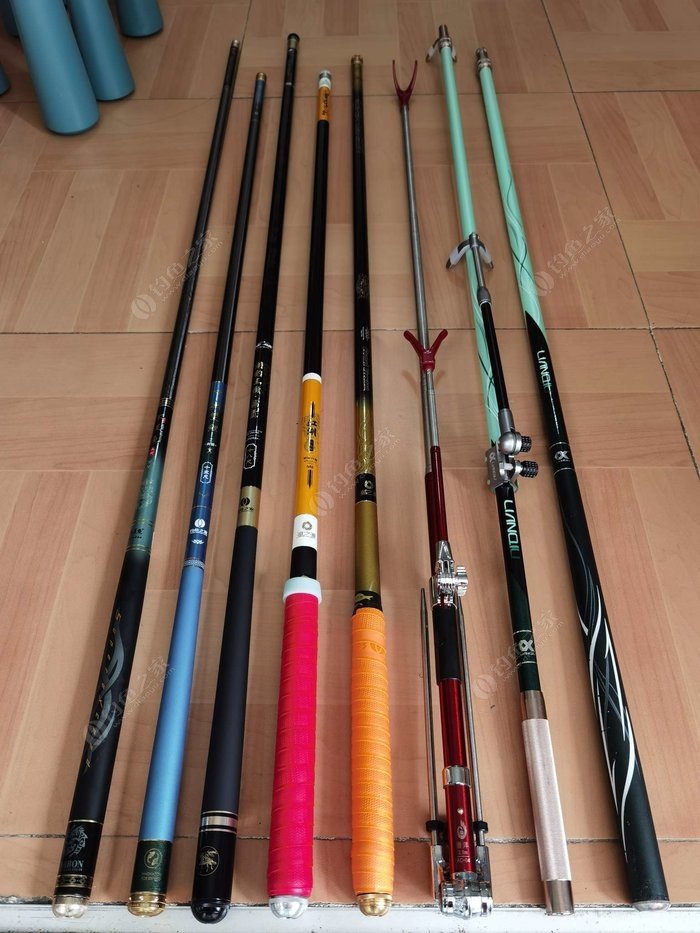
These are the thin, light, stiff ones. They come in 3.6m, 4.5m, 5.4m (standard tournament lengths) and have a spindle-shaped handle for comfort. Some have “convertible” handles (swap the butt to make a 5.4m into a 4.5m) or “lockable” sections (pull out 3 sections of a 4.5m rod to make a 3.6m). But here’s the problem: changing the length messes with the rod’s design. The second section (meant for lifting fish) becomes the “control” section when you shorten it. I tried this once—hooked a 100g crucian, and the rod bent so much I thought it would break. Never again.
Stream Rods (For… Streams, Duh)
These are shorter (folded length 52-80cm), straight-handled, and less stiff. They’re for small streams where you don’t need to cast far. But don’t use them in tournaments—they’re too soft for fast hooksets.
Long Rods (For Big Water)
8-16m rods? Those are for lakes or rivers where you need to cast far. But they’re too long for tournaments—you can’t cast 400 times with a 10m rod without your arm falling off. Also, the float is too far away to see tiny bites. A pro once told me: “6.3m is the limit for pool tournaments. Any longer, and you’re just guessing if the float moved.”
A Quick History: From Bamboo to Carbon Fiber (And Why We Got Stuck with 3.6m Rods)
Back in the day, we used bamboo or reed rods. They were light, but not stiff. Then came fiberglass rods in the 1980s—game over for bamboo. But fiberglass was heavy. Then carbon fiber hit, and suddenly rods got thin, light, and stiff. But why 3.6m, 4.5m, 5.4m? Blame international trade. We copied Japanese and Taiwanese rod specs, and now 90% of tournament rods are these lengths. Wild fishing? These rods are useless—too short, too stiff. But tournaments? They’re mandatory.
Final Thought: Thin, Light, Stiff Is Great… But Know When to Ditch It
I’ve spent years chasing the “perfect” tournament rod. I’ve bought rods that felt like air but broke on the first big fish. I’ve used rods that were too heavy but caught more fish because I didn’t break line. Here’s the truth: thin, light, stiff is a tool, not a religion. It works for fast, small fish in high-density tournaments. But if you’re fishing for big carp, mixed species, or just having fun? Grab a rod that feels good in your hand, not one that checks a box. I once used a 10-year-old fiberglass rod in a friendly match and caught more fish than anyone with their fancy carbon rods. Why? Because I knew how to use it. The rod doesn’t make the fisherman—your skill does. (But let’s be real: a light rod helps your arm.)
Oh, and one last thing: always use a rod with a butt ring for a safety line. I’ve seen pros hook 5kg carp with a 3.6m rod and save the day by letting out the safety line. Without it? Their rod would’ve snapped. Trust me—you don’t want to be the guy who breaks a $500 rod because he forgot the safety line.